
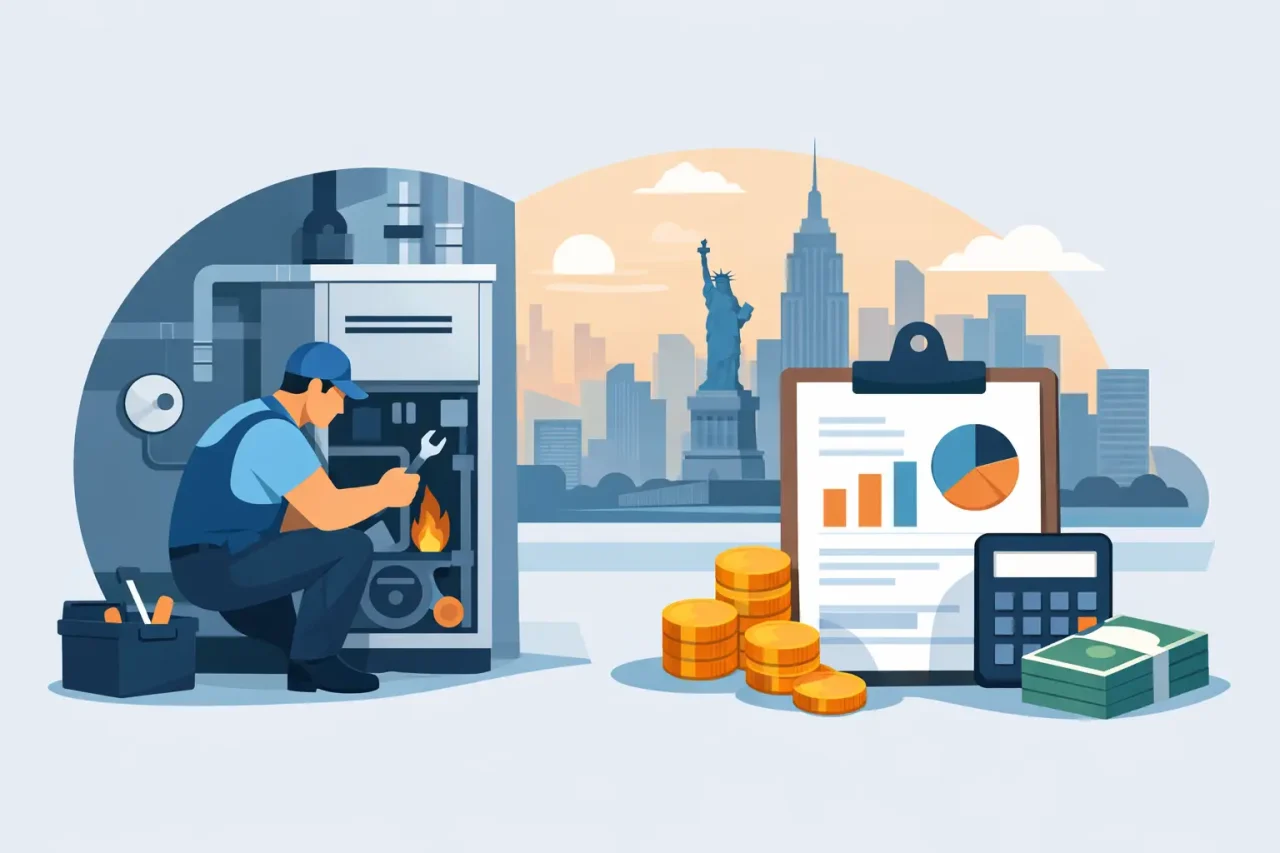
When the heat cuts out on a January night in New York, furnace repair cost stops being a casual question and becomes an urgent one. Homeowners, landlords, and property managers want the same answer fast – what is this going to cost, how soon can it be fixed, and is it worth repairing at all?
The honest answer is that furnace repairs vary widely. A simple ignition issue can be a manageable service call. A failed blower motor, cracked component, or control board problem can push the bill much higher. What matters most is getting a clear diagnosis quickly, because the longer a furnace runs with a fault, the more likely one issue turns into several.
What affects furnace repair cost
The biggest factor is the part that failed. Some repairs involve a basic adjustment, cleaning, sensor replacement, or thermostat correction. Others require major electrical or mechanical components, and those parts are more expensive before labor is even added.
System type also matters. Gas furnaces, oil furnaces, and older heating systems each have different parts, safety checks, and repair procedures. In New York City and the surrounding area, many properties also have aging equipment packed into tight mechanical spaces, which can increase labor time compared with a newer system in an easily accessible basement.
Timing can affect price as well. Emergency service during a cold snap, after-hours calls, or weekend repairs may cost more than a standard daytime appointment. For many customers, that premium is worth it. When your building has no heat, waiting is not always an option.
Finally, condition matters. If a furnace has gone years without maintenance, the first visible problem may not be the only one. Dirty burners, worn belts, airflow restrictions, clogged filters, and failing safety controls often show up together. That is why a dependable technician should explain not just the immediate repair, but the overall condition of the system.
Typical furnace repair cost ranges
Most customers want a ballpark figure, and that is fair. While exact pricing depends on the equipment and the issue, furnace repair cost often falls into a few general ranges.
Minor repairs are usually the lowest-cost category. These can include replacing a flame sensor, addressing a clogged filter issue, recalibrating a thermostat, relighting or correcting ignition-related problems, or tightening electrical connections. In many cases, these repairs stay on the lower end because the part cost is modest and labor time is limited.
Mid-range repairs often involve components such as pressure switches, inducer motors, igniters, capacitors, limit switches, or smaller control issues. These jobs take more diagnosis and often more disassembly. They are not the cheapest fixes, but they can still be a smart investment if the furnace is otherwise in good condition.
Major repairs are where cost climbs quickly. A failed blower motor, control board, heat exchanger-related issue, or oil burner assembly problem can be expensive. At that point, the question is no longer just how much the repair costs. It becomes whether the repair adds enough life and reliability to justify the spend.
That is why price without context can be misleading. A $300 repair on a stable system may be excellent value. An $1,100 repair on a 20-year-old furnace with repeated breakdowns may not be.
Why prices in NYC can look different
New York area properties come with real-world complications that affect heating service. Access can be tighter, parking and travel time can be more difficult, and many buildings have older systems that require extra care. In multifamily buildings and commercial properties, technicians may also need to coordinate with tenants, supers, or management staff before work even begins.
There is also the urgency factor. In the Bronx, Manhattan, Brooklyn, Queens, Westchester, and nearby counties, heat loss during winter is not a minor inconvenience. It can become a safety issue, especially for families with children, older adults, or tenants in occupied buildings. Fast response matters, and experienced emergency service carries value because the goal is not just to inspect the furnace – it is to restore heat as quickly and safely as possible.
Common furnace problems and what they usually mean for cost
A furnace that will not start may be dealing with something simple, like a thermostat issue, tripped switch, dirty sensor, or ignition problem. These repairs are often more affordable than customers fear, especially when caught early.
Strange noises are harder to predict. Banging, squealing, rattling, or humming can point to loose components, belt problems, blower issues, motor wear, or burner irregularities. Some are quick fixes. Others are warning signs that a larger part is on the way out.
Weak airflow may come from a clogged filter, blocked ductwork, blower trouble, or a failing motor. The furnace may still be producing heat, but not moving it effectively through the space. Costs here depend on whether the issue is basic maintenance, a duct problem, or a component replacement.
Short cycling, where the furnace turns on and off too often, can raise energy bills and wear out parts faster. The cause might be a dirty flame sensor, overheating from restricted airflow, thermostat trouble, or a deeper control issue. Short cycling is one of those problems that is cheaper to address early than after repeated stress damages other parts.
When repair makes sense and when replacement is smarter
Not every expensive repair is a bad decision. If the furnace is relatively new, sized properly, and has been dependable until now, replacing a major part can still make financial sense. A good repair can restore performance and buy you several more years of reliable service.
But there is a line. If your furnace is near the end of its expected life, breaking down repeatedly, driving up fuel costs, or showing signs of broader wear, replacement may be the better move. This is especially true if a repair involves a major safety concern or a very costly component.
A simple rule many property owners use is this: if the repair is significant and the system is old, compare the repair price against the value of replacement, efficiency, warranty protection, and peace of mind. Paying less today is not always cheaper over the next two winters.
How to avoid paying more than necessary
The best way to control furnace repair cost is to catch problems before they become emergencies. Annual maintenance helps identify worn parts, dirty components, airflow restrictions, and safety issues before the system fails on the coldest day of the year.
Clear communication matters too. You should expect a technician to explain what failed, why it failed, what the repair includes, and whether there are any related concerns. Straightforward pricing is not just about the number. It is about understanding what you are paying for and what result to expect.
It also helps to act when you notice early warning signs. If your furnace is making unusual noise, struggling to keep temperature, cycling oddly, or producing weak airflow, do not wait for a full shutdown. Small symptoms often lead to larger repair bills when ignored.
What to ask before approving a furnace repair
Before you say yes to any major repair, ask a few practical questions. Is this the only failed component, or are there signs of additional wear? How old is the furnace, and how much useful life is likely left after this repair? Will the repair restore reliable operation, or is it more of a short-term patch?
Those questions matter because the cheapest immediate option is not always the strongest long-term decision. For homeowners, that means protecting comfort and avoiding another midnight outage. For landlords and commercial operators, it means protecting tenants, operations, and winter safety without repeat service calls.
At FT’s Precise Heating & Cooling, the goal is simple: fast diagnosis, clear answers, and getting heat back on without unnecessary delays. That is what customers need when a furnace problem shifts from annoyance to emergency.
Furnace repair cost is really about value
The number on the estimate matters, but so does what comes with it. A proper repair means accurate diagnosis, safe workmanship, reliable parts, and confidence that the system will do its job when temperatures drop again tonight. In New York winters, that is not a luxury. It is part of keeping your home, tenants, or business protected.
If your furnace is showing signs of trouble, the smartest move is usually the fastest one: get it checked before a smaller repair turns into a bigger disruption.