
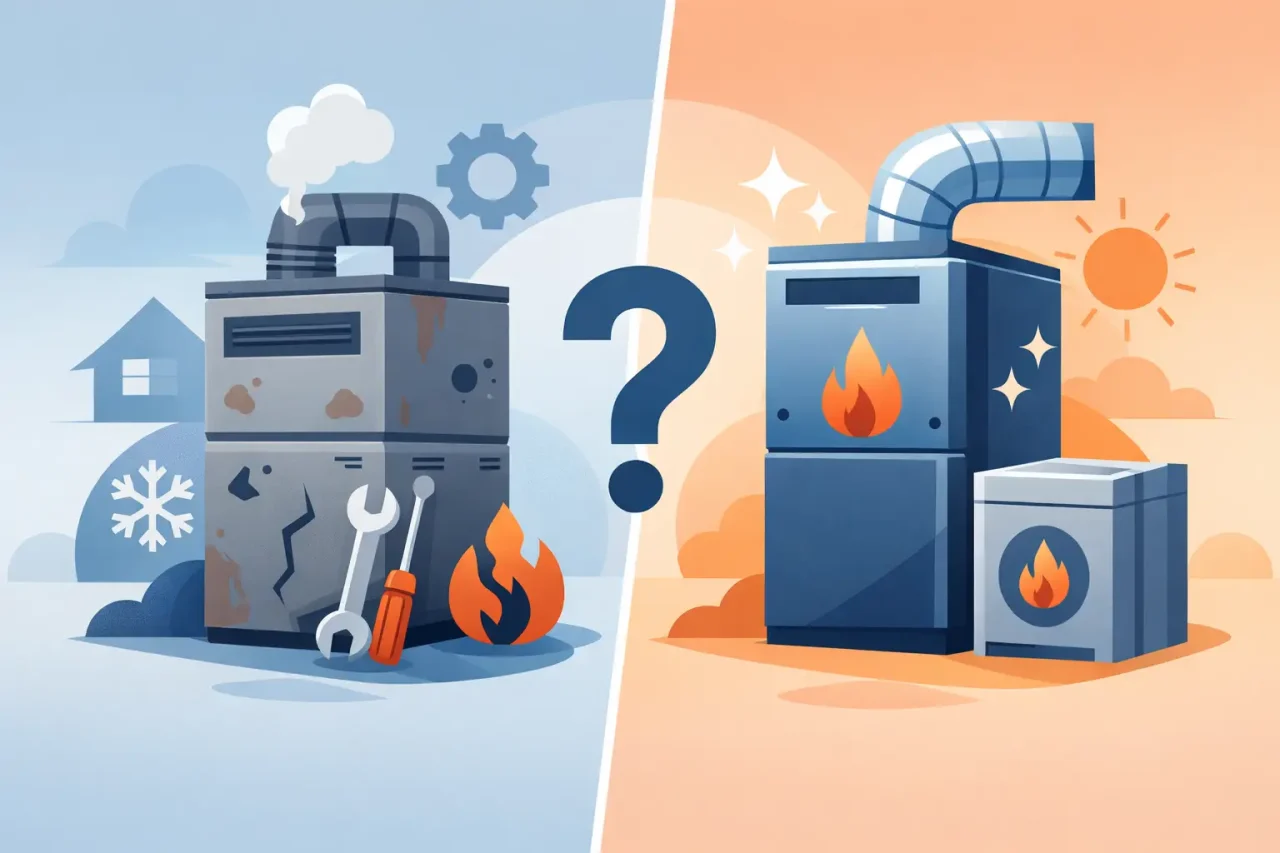
The question usually hits at the worst time – right when the apartment gets cold, tenants start calling, or your business opens to weak heat on a January morning. If you are trying to decide whether to repair or replace old furnace equipment, the right answer depends on more than one repair bill. It comes down to safety, reliability, operating cost, and how much risk you can afford during a New York winter.
For homeowners, property managers, and commercial operators, this is not just a comfort issue. An aging furnace can turn into an emergency fast. What starts as strange cycling, uneven heat, or a burning smell can end with a no-heat call on the coldest night of the week. That is why the smartest decision is usually the one that protects the property before the furnace makes the decision for you.
When repair makes sense
Not every old furnace needs to be replaced. In many cases, a targeted repair is the practical call, especially if the system has been maintained, the heat exchanger is sound, and the issue is isolated.
If your furnace is under 12 to 15 years old and the problem is something straightforward like a failing igniter, dirty flame sensor, blower issue, or thermostat problem, repair is often the better investment. The same is true when the unit has a solid service history and has not been breaking down repeatedly.
A repair also makes sense when the system still heats the space evenly and your energy bills have not changed much. One part failure does not automatically mean the whole furnace is finished. What matters is whether the repair restores dependable operation without putting you back in the same situation a few weeks later.
For some building owners, timing matters too. If a repair can safely get you through the heating season and allow time to plan for replacement in the spring or early fall, that can be a reasonable strategy. The key word is safely. Delaying replacement only works when the system is still dependable enough to carry the load.
When to replace an old furnace
There is a point where repairing an aging furnace stops being cost-conscious and starts becoming expensive hesitation. If your unit is 15 to 20 years old, needs frequent service, or struggles to keep up in cold weather, replacement deserves serious attention.
The biggest sign is repeated breakdowns. If you are paying for service calls every winter, replacing components one at a time, and still dealing with uneven heat or unexpected shutdowns, the furnace is telling you it is nearing the end of its useful life. A repair may get it running today, but it may not give you real confidence tomorrow.
Rising utility costs are another warning sign. Older furnaces lose efficiency over time, especially if burners, blower components, or internal controls are wearing down. You may not notice the decline all at once. It often shows up as longer run times, weak airflow, rooms that never feel fully warm, and heating bills that keep climbing.
Then there is safety. If there are signs of a cracked heat exchanger, combustion issues, persistent gas odor, soot, or carbon monoxide concerns, replacement is often the safer route. At that point, the conversation is no longer just about cost. It is about protecting people in the building.
Repair or replace old furnace systems based on age
Age is not the only factor, but it matters. A 10-year-old furnace with one failed part is very different from an 18-year-old furnace with multiple worn components.
As a general rule, furnaces in the 0 to 10 year range are usually worth repairing if the issue is isolated. In the 10 to 15 year range, the decision starts to depend on repair cost, maintenance history, and overall performance. Once a furnace moves past 15 years, replacement becomes more likely, especially if you are seeing comfort issues, noise, poor airflow, or recurring no-heat calls.
For multifamily properties and commercial spaces, that age calculation gets even more practical. The cost of downtime is not limited to the equipment itself. It can mean tenant complaints, emergency dispatches, temporary heating measures, or disrupted operations. An older furnace that still technically runs may still be a liability.
The repair cost rule that actually helps
Many people have heard some version of the repair-versus-replace formula, but the real value is using it with context. If a repair is going to cost a large percentage of what a replacement would cost, and the furnace is already near the end of its expected life, replacement usually makes more financial sense.
For example, spending a modest amount on a repair for a well-maintained mid-life furnace can be smart. Spending a major amount on an aging furnace with declining performance usually is not. That is especially true if the repair does not address the bigger issue of reliability.
What property owners often miss is the hidden cost of delay. One repair bill may seem cheaper than replacement, but if that repair is followed by another service call, another failed part, and another stretch of uncomfortable indoor temperatures, the total cost climbs quickly. Add in emergency timing, after-hours service, or lost business, and replacement starts to look much more reasonable.
Signs your furnace is becoming unreliable
Some furnaces fail all at once. Many give warnings first.
If your system is making banging, rattling, humming, or screeching noises, it should be checked. If the burner cycles on and off too often, if some rooms stay cold, or if airflow feels weak even when the thermostat is set correctly, those are operational signs that something is off.
Dust, dry air, and stale indoor conditions can also point to a struggling heating system, especially when paired with an older unit. So can a pilot or ignition problem, a yellow burner flame instead of blue, or a furnace that runs constantly without reaching the desired temperature.
These symptoms do not always mean replacement is necessary, but they do mean waiting is risky. In New York, heating problems rarely improve by being ignored. They usually show up again at the worst possible moment.
What makes replacement worth it
Replacing an old furnace is a bigger upfront decision, but it can solve multiple problems at once. A newer system can improve heating consistency, lower operating costs, reduce emergency repair risk, and give you more confidence when temperatures drop.
It can also bring the rest of the system up to a better standard. If your thermostat controls are outdated, airflow is poor, or the existing equipment is mismatched to the space, replacement gives you a chance to correct those issues instead of patching around them.
For homes, that often means quieter operation and more even comfort. For property managers, it can mean fewer tenant complaints and fewer surprise service calls. For commercial operators, it can mean better continuity during the months when heating failure is not just inconvenient but disruptive.
That is where a clear diagnosis matters. The right contractor should not push replacement when a safe, durable repair will do. But they also should not pretend an aging furnace is fine when all signs point toward continued breakdowns.
How to make the right call before winter gets worse
If you are unsure whether to repair or replace old furnace equipment, start with three questions. Is it safe? Is it reliable? Is the next repair really buying time, or just postponing a replacement you already know is coming?
If the furnace is relatively young, the problem is isolated, and the system has been dependable, repair may be the right move. If it is older, breaking down often, driving up bills, or showing signs of wear that affect safety or performance, replacement is usually the stronger long-term decision.
In the New York area, where winter failures can quickly become urgent, speed and clarity matter. A licensed technician should be able to inspect the system, explain the condition in plain language, and help you weigh cost against risk. That is the standard customers should expect from a local company that understands how fast heat loss can become a serious problem.
At FT’s Precise Heating & Cooling, the goal is simple – fast diagnosis, clear answers, and getting your heat restored with the option that truly fits the condition of the system.
If your furnace has been giving you warning signs, do not wait for a full shutdown to force the decision. The best time to deal with an old heating system is before it leaves your property cold.