
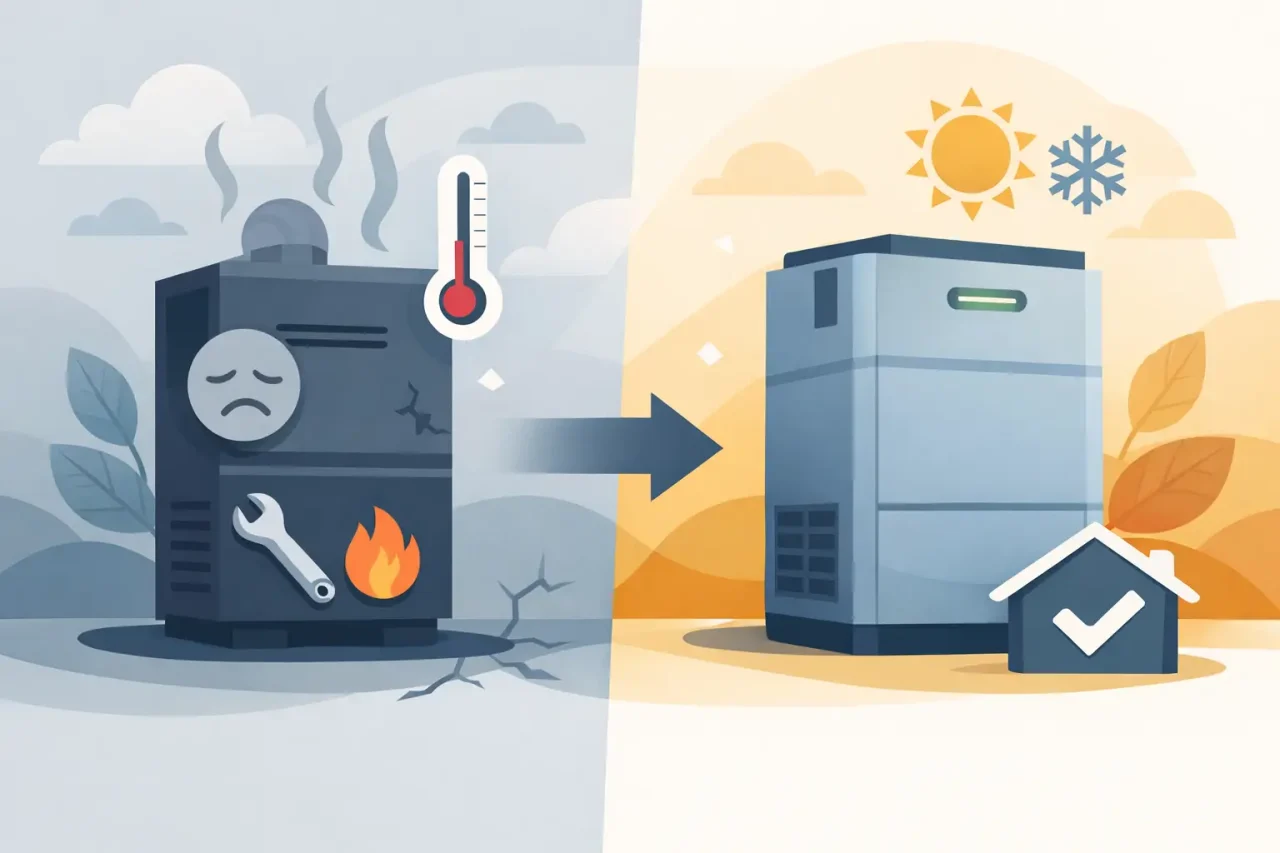
A furnace rarely quits at a convenient time. In New York, it usually happens on the coldest night of the week, when tenants are calling, pipes are at risk, or your family is piling on blankets and waiting for heat to come back. If you are asking when should I replace my furnace, the right answer depends on age, repair history, safety, efficiency, and how reliable the system feels going into winter.
When should I replace my furnace instead of repairing it?
The clearest answer starts with age. Most furnaces last around 15 to 20 years, but that range is not a guarantee. A well-maintained unit may push a little longer. A neglected system, or one working hard through repeated New York winters, may show serious decline sooner.
If your furnace is over 15 years old and starting to need regular repairs, replacement usually deserves serious consideration. If it is over 20 years old, the question is often less about whether it can be repaired and more about how much longer you should trust it. Older systems do not just break more often. They also tend to heat less evenly, run longer, and cost more to operate.
That matters for homeowners, but it matters just as much for property managers and commercial operators. A furnace that limps along can still create tenant complaints, comfort issues, and emergency service calls that hit at the worst possible time.
The biggest signs your furnace is nearing the end
A furnace does not always fail all at once. In many cases, it gives warnings first. The issue is that people often normalize those warnings until the problem becomes urgent.
One common sign is frequent repair work. If you have already replaced an ignitor, repaired a blower issue, dealt with a faulty limit switch, and now another problem shows up, the pattern matters. One repair is normal. Several repairs in a short span usually mean the system is wearing out as a whole.
Another warning sign is uneven heat. If one room feels warm and another stays cold, the issue could be ductwork, airflow, thermostat placement, or the furnace itself. But if your system is aging and struggling to maintain consistent comfort, replacement may be the more stable long-term fix.
Strange noises also deserve attention. Banging, rattling, screeching, or booming sounds can point to loose parts, delayed ignition, airflow issues, or internal wear. Not every noise means you need a new furnace, but recurring noise from an older system is a sign not to ignore.
Watch your energy bills too. If usage habits have not changed but heating costs keep climbing, your furnace may be losing efficiency. Older gas and oil furnaces often consume more fuel as components wear down and performance slips.
Then there is the simplest sign of all – your furnace struggles to keep up. If it runs constantly, cycles too often, or cannot maintain the temperature you set, that is more than an annoyance. It is a sign the system may no longer be dependable when you need it most.
Age matters, but repair cost matters too
A lot of customers want a simple rule, and one practical rule is this: if the repair is expensive and the furnace is already old, replacement usually makes more financial sense.
A newer furnace with a single failed part is often worth repairing. An older furnace with a cracked heat exchanger, failing motor, ignition problems, and rising energy costs is a different situation. Putting more money into a declining unit can turn into repeated spending without real peace of mind.
Many HVAC professionals use a version of the repair-versus-replace calculation based on age and repair cost. The exact formula can vary, but the logic is straightforward. The older the system, the less sense it makes to pour major money into it.
For example, if your furnace is 17 years old and the repair is substantial, replacement is often the safer call. You are not just paying for a repair. You are betting that the rest of the system will hold together. That bet gets riskier with age.
Safety issues change the decision fast
Comfort matters, but safety comes first.
If a furnace has a cracked heat exchanger, combustion problem, gas leak concern, or carbon monoxide risk, replacement may move from a budgeting decision to a safety decision. Some problems can be corrected, but some indicate that the unit is no longer a reliable or safe piece of equipment.
This is especially important in tightly occupied homes, apartment buildings, and commercial spaces. If your system is showing signs of unsafe operation, waiting it out is not a responsible plan. A professional inspection can confirm what is happening, but once safety is in question, replacement often becomes the right move quickly.
Efficiency is not just about lower bills
People often think furnace efficiency only matters if they want to save money on utilities. That is part of it, but not the full picture.
A more efficient furnace can also heat more consistently, recover temperature faster, and reduce strain during severe cold. In older buildings across the Bronx, Manhattan, Brooklyn, Queens, and nearby areas, heating systems often work harder than people realize. If your current unit is inefficient, it may leave you with cold spots, longer run times, and a system that feels like it is always behind.
That does not mean every older furnace must be replaced just because a newer model is more efficient. If your unit is functioning well, has been maintained properly, and is not costing you heavily in repairs or fuel, repair may still be reasonable. But if efficiency problems are showing up alongside age and reliability issues, replacement becomes easier to justify.
What if the furnace still works?
This is where the decision gets real. Plenty of furnaces still operate even when they are past their prime. The fact that it turns on does not always mean it is worth keeping.
A working furnace can still be too unreliable for another winter. It can still be noisy, inefficient, or one breakdown away from leaving a property without heat during freezing weather. If you are constantly wondering whether it will make it through the season, that uncertainty has a cost too.
For homeowners, that cost is stress and discomfort. For landlords and property managers, it can become complaints, emergency calls, and possible building issues. For commercial operators, it can affect staff, customers, and business continuity.
In those cases, proactive replacement is often better than waiting for a full shutdown in January.
When repair is still the right move
Not every furnace problem means replacement. If the unit is relatively young, the repair is minor, and the overall system has been reliable, fixing it is often the smart choice.
A bad flame sensor, worn ignitor, clogged filter issue, or thermostat problem does not automatically mean the furnace is at the end. Sometimes the real value comes from a clear diagnosis instead of guessing. The goal is not to replace equipment too soon. The goal is to avoid wasting money on a system that is already telling you it is done.
That is why honest evaluation matters. You want a technician who can explain what failed, what condition the rest of the furnace is in, and whether repair is likely to buy you meaningful time.
Should you replace your furnace before winter?
If your furnace is aging and already showing warning signs, yes, replacing it before winter is often the smarter move.
Emergency replacement in freezing weather is harder on everyone. You may have fewer scheduling options, higher stress, and immediate pressure to make a decision. Replacing a questionable furnace before peak cold gives you more control over timing and planning.
This is especially true for multi-unit properties and commercial spaces where a heating outage affects more than one household or one room. Waiting until failure can turn a manageable project into a true emergency.
At FT’s Precise Heating & Cooling, that is why fast diagnosis and straight answers matter. People do not need guesswork when the temperature drops. They need to know whether a repair is worth it or whether it is time to move on.
A simple way to make the call
If you are unsure when should I replace my furnace, ask yourself a few practical questions. Is it over 15 years old? Have repairs become more frequent? Are bills climbing? Is heat uneven or unreliable? Do you trust it to get through the next hard freeze?
If the answer to several of those is yes, replacement is probably the safer and more cost-effective path. If the system is newer and the issue is isolated, repair may still be the right decision.
The best time to deal with a furnace is before it leaves you without heat. If your system is showing its age, listen to what it is telling you now instead of waiting for it to say it louder on the coldest day of the year.